Women Weaving Stories … And Men Appropriating Them?
Lecturer Jan Parker explores some of the ideas which inspire her new course on Odysseus and Storytelling.
The course will explore the owning and losing of stories in the Odyssey: Circe’s, Calypso’s, Nausicaa’s, Penelope’s - and Odysseus’ own. Here, Jan also considers some recent books which retell Greek myths from a woman’s point of view.
‘Is he the one whose story is told while I’m weaving?’ ask the chorus of Athenian women in Euripides’ play Ion, entering the ‘set’ of the outside of the temple of Apollo at Delphi, pointing out to one another characters on the temple sculptures.
Weaving stories; weaving stories: these are women from anywhere and everywhere in the ancient Greek world, sharing their stories to the rhythm of the shuttle.
But our traditions suggest that the shapers of myths for posterity tend to be men: Grimm sent his wife to collect the stories from the wise women storytellers; ‘nursery’ stories are in many (most?) cultures passed on to children by mothers and nurses. Professor Wendy Doniger was censored and her book, The Hindus: An Alternative History burned for research showing that women storytellers contributed to the Hindu Sacred Scriptures when they were still oral. (Three recent books magnificently scope this subject for Greece: see below.)
In the Odyssey, the focus from the 6th century BCE up to Christopher Nolan’s blockbuster (due to be released in July 2026), has usually been on malerepresentation of female characters’ stories. Elon Musk is the latest to wade into the question of how a Homeric woman should be seen by saying that Oscar winning actress Lupita Nyong'o should not play Helen.
But as we discussed in an earlier course, Helen is fascinating precisely because she is mythical. Indeed, she is preeminently a figure represented as reflecting on and controlling her own myth! (She reputedly blinded Stesichorus, a 6thC BCE poet for using the trope that Helen was to blame for the Trojan War, until he wrote a ‘taking back ode - a palinode - exculpating her. I end with the very human line Homer gives her, that she is fated always to be a subject for song, as indeed she is!)
So – what do we make of Homer as a storyteller of women?
We first meet Circe at her weaving: Odysseus’ men could hear:
Circe’s sweet voice singing inside, as she went to and fro in front of a vast divine tapestry, weaving the finely-made, lovely, shining work.
Weaving and singing . . . women’s powerful tools to enchant: even as told by Odysseus as he ‘sings for his supper’ (that is, he tells his stories in recompense for the gracious hosting and return passage). This is a woman who can control her own story. And, indeed, we know that only part of her story is brought into Odysseus’ narrative: a whole epic, the Telegony, tells of the future of both her and their son Telegonus. But when Odysseus has recounted the ‘shining tale’ in Odyssey book 10, he moves on. And Homer shows us that bardic treatment, that shaping of material, in operation.
And in so doing, I want to argue, Homer shows us the stories that should have been, before Odysseus intervened: Nausicaa, fated to marry a glorious prince ‘from outside’; Calypso, the ‘coverer’ able to sacrifice an immortal marriage for love of a human.
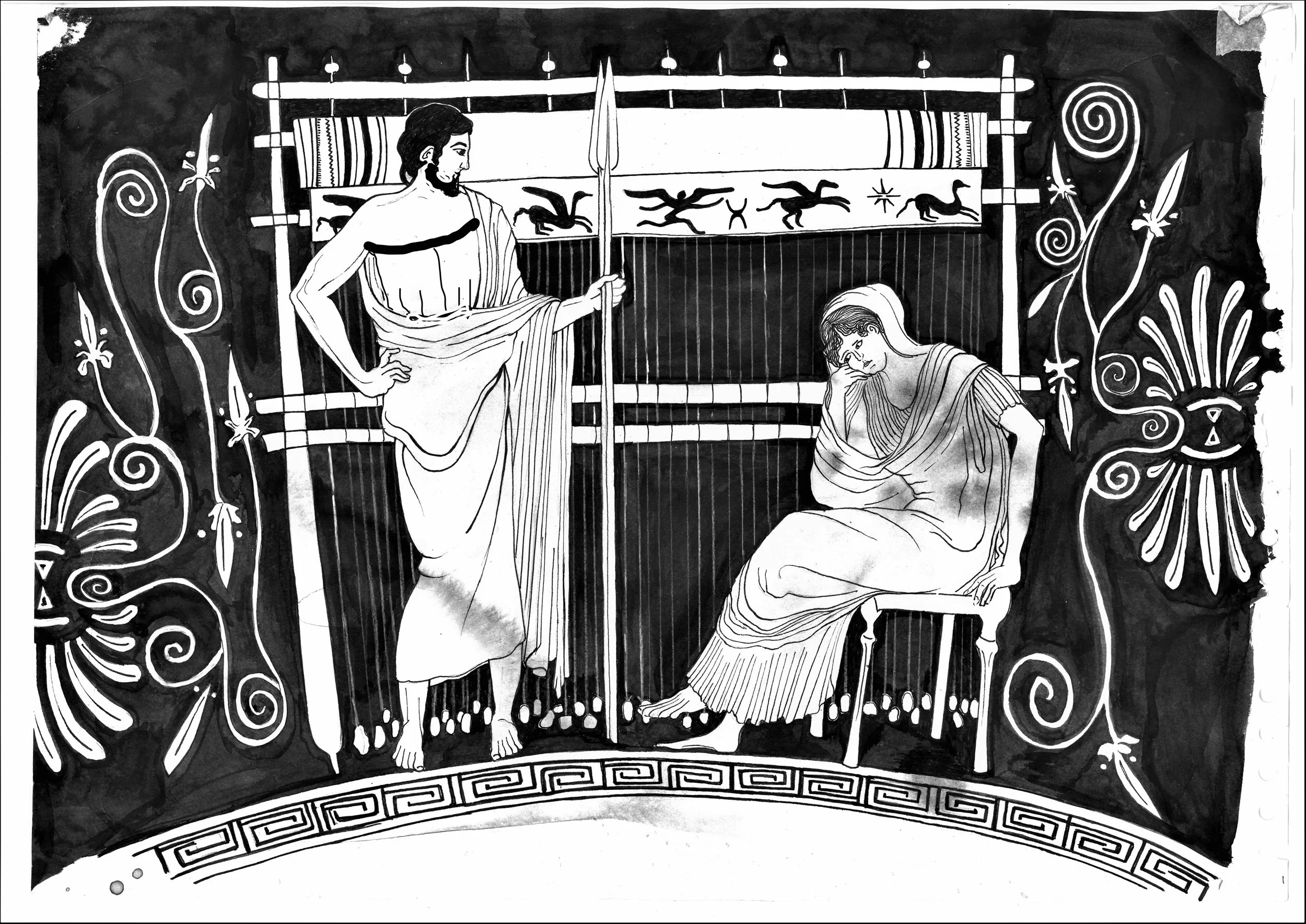
But, as feminists through the ages have pointed out, Penelope is outside Odysseus’ narrative and outside Odysseus’ narrative control. We meet her throughout as an independent woman, dealing as a single head of the household with a growing son and unruly suitors. And her weaving – of her father-in-law’s shroud that she weaves by day and unpicks by night - is not to enchant men but to preserve her independence.
I want to explore all three aspects: of Odysseus’ storytelling of his adventures among goddesses with magic powers; of Homer’s framing of Circe’s, Calypso’s and Nausicaa’s stories; and finally of Penelope. For when Odysseus lands back on Ithaca, he is no longer a bard in control of his narrative identity but someone within Penelope’s world, someone needing the validation and recognition that only she can give.
Women’s weaving and storytelling
There have been many female retellings of Greek myths. For example:
• Charlotte Higgins’ beautiful weaving together of Greek myths as threads in a tapestry of myths, framed by Ariadne the weaver: Greek Myths A New Retelling (2021). This book puts female characters at the heart of the story.
• Daisy Dunn’s equally wonderful use of the weaving analogy in The Missing Thread: A New History of the Ancient World Through the Women Who Shaped It (2025).
• Natalie Haynes’ Pandora's Jar: Women in the Greek Myths (2021)and Divine Might: Goddesses in Greek Myth (2024).
(You don’t need to buy any of these books for the course, but we have provided links to sellers such as UK Bookshop.org in case you want to explore these ideas further.)
There are also female retellings of individual myths: for instance, since classicist Natalie Haynes’ Stone Blind, there have been three other envoicings of Medusa by Rosie Hewlitt, Jessica Burton and Ayana Gray; classicists Jennifer Saint and Emily Hauser have ‘re-envoiced’ Aphrodite, Ariadne, Atalanta (x2), Elektra, Hera and Hippolyta. As I write an advert pops up of Jane Dougherty’s just published Pasiphae: An Incredible Feminist Retelling of a Woman Wronged by Myth. Madeline Miller has written two classic novels, Circe and The Sword of Achilles, that stand comparison with Margaret Atwood’s iconic Penelopiad: all three, though informed by feminist classical scholarship, are truly works of the imagination.
But I have been most interested in, and at times vexed by, stories aiming to ‘correct Homer’s, women-silencing masculine/ist, and/or outrightly patriarchal narrative’: debatably so in Pat Barker’s outstanding trilogy The Silence of the Girls (sic) and The Women of Troy, hailed as a ‘Myth for a #MeToo age’, and the non-Homeric The Voyage Home. But somewhat egregiously so in novelist Emily Hauser’s just published M Y T H I C A: Penelope’s Bones: A New History of Homer’s World, Through the Women Written Out Of It.
First and obviously: the status and dark, life-experience-formed sensibility of Briseis and the women of Troy in the Iliad is unforgettably described by Homer in some of the most powerfully affecting scenes ever crafted:
Andromache smiling through her tears when Hector, coming to say goodbye before going out to his death and knowing what her fate will be, has to take off his frightening horse-crested helmet before cradling his baby. Briseis and the other captive women lamenting over the body of Patroclus ‘who was always kind to them’, ‘crying in common for him but each also for her own lot’. And Helen, a very human Helen, reflecting on her fate and that despite all, Priam was always good to her.
But secondly, and surely equally obviously, for the simple reason that she takes Homer’s women to be ‘really’ portrayed, and so to be subject to a double disenvoicing: by the male poet and the patriarchal world he represents, and represents as real and therefore - somehow – endorses as valid. We have become used to dozens of accounts of mythical figures from a modern point of view (as above, and indeed Emily Hauser’s own story of Chryseis in For the Most Beautiful) and the dark reframing of the Trojan Women not as iconic victims as Euripides’ Trojan Women, standing for all time as examples of the treatment of women in war, but as particular, particularised victims (as Pat Barker’s gritty reimaginings).
This book, I think, in searching for ‘victims of patriarchy’ across the Near and Middle East looks too crudely into stories, into myths, to prove and call out a – necessarily narrow and somewhat obvious - historical point about the place, but not the lived experience, of women. And personally I find the calling out in the Trojan Women of the treatment of women in war or in the Odyssey of the struggles of a long single woman trying to hold everything together in a crudely, toxically male society, to need no womansplaining!
For the point of remaking myths, of retelling stories, is that they affect, provoke, are memorable, are good to think with, newly as they are told and retold. Such characters’ stories are always being given new meanings, new significances, new implications, whenever women, and men, gather to hear them, precisely because they are myths. But great retellings carry on affecting across times and cultures because they are talking about transhistorically recognisable facets of human nature, the human condition, human psychology.
Homer has the very human Helen of the Iliad reflect:
On us the gods have set an evil destiny,
That we should be a singer's theme
For generations to come. (Iliad 6.357-58)
And each singer, each reader meets and is affected by a Helen, Hecuba or Penelope afresh.
Join us for a new course on Odysseus and Storytelling: Live Online with Dr Jan Parker, University of Cambridge.
Wednesdays, 6 May to 20 May 2026, 6.00-8.00 pm British Summer Time.
Lecture 1. Penelope’s Ithaca, Helen’s Sparta and Odysseus’ final hosts: Queen Arete, Princess Nausicaa on Phaeacia Odyssey, Books 4, 6, 7
Lecture 2. Odysseus as bard: storying the world of his travels, storying other women, human and magic. Odyssey, Books 5, 9-12
Lecture 3. Return to Ithaca: Penelope’s story … and aftermath. Odyssey, Books 19-24