Book Review: Gardens in the Work of Virginia Woolf
Helen Rees Leahy reviews Karina Jakubowicz’s brilliant new book on Virginia Woolf.
Karina Jakubowicz, Gardens in the Work of Virginia Woolf: Nature, Modernity and the Politics of Space (Edinburgh University Press, 2026).
Virginia Woolf lived and wrote in gardens. From her childhood home, a short walk from Kensington Gardens, to the squares of Bloomsbury and the gardens at Monks House, Charleston and Sissinghurst, Woolf was intensely aware of gardens as spaces that structure social relations and which invite aesthetic and sensory responses. The gardens of her adult life were as integral to the geography of Bloomsbury as its houses and their interiors: their design and meaning equally open to cultural encoding and decoding. Just as daily outings to Kensington Gardens once calibrated the disciplinary norms of her youth so, in later life, the gardens of her friends became private enclosures for more permissive personal and social relations. Above all, her own garden provided the physical and imaginative space that she needed for her work. Woolf’s creation of a room of her own in the garden of Monks House was surely more than a practical arrangement. She knew that gardens are psychic, as well as physical, spaces, capable of generating and holding emotions and memories. It was no coincidence that this was where she chose to write.
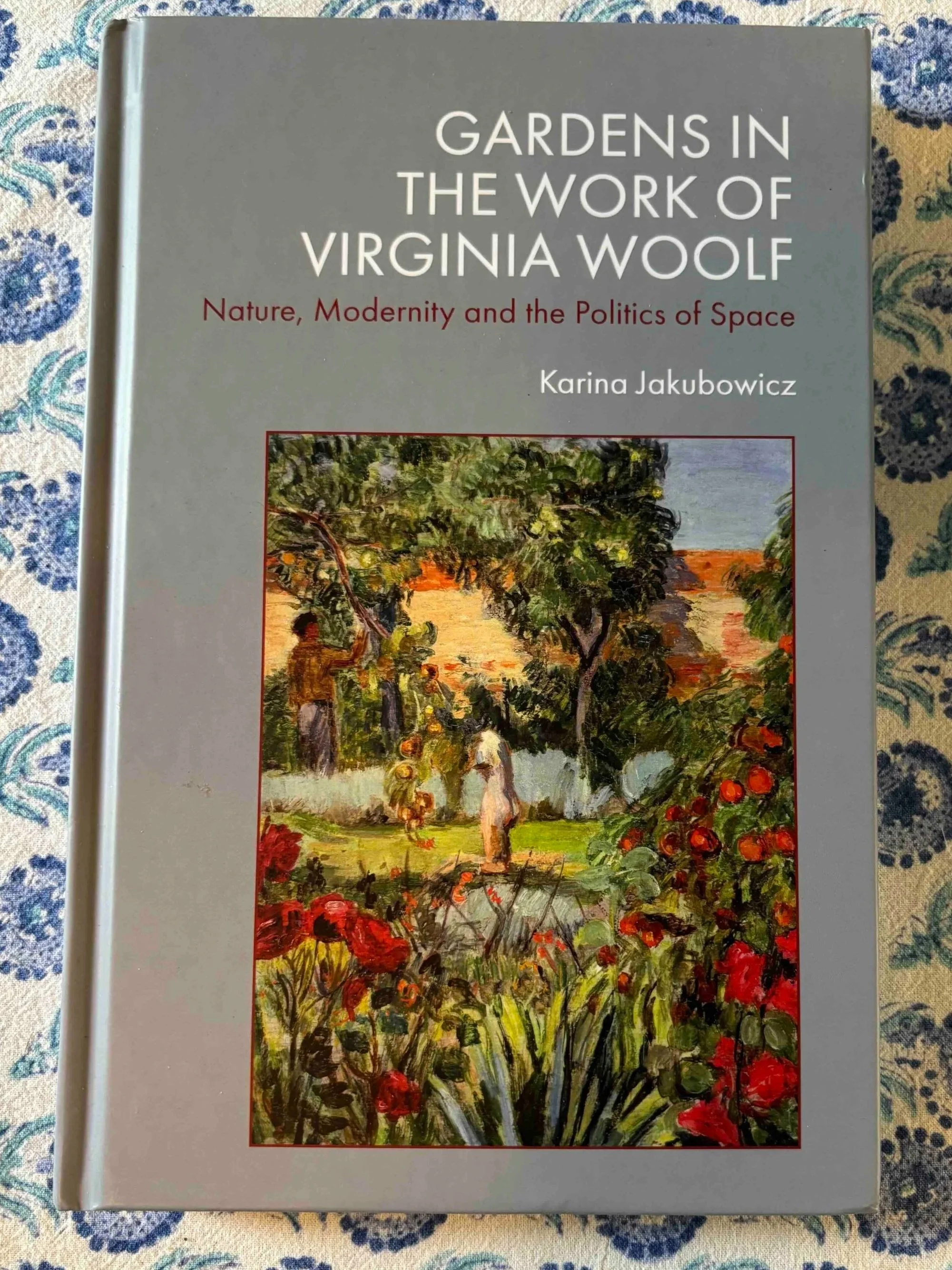
These observations prepare the ground for Karina Jakubowicz’s lucid study of Gardens in the Work of Virginia Woolf, the first monograph devoted to the importance of gardens in her writing. Subtitled Nature, Modernity and the Politics of Space, Jakubowicz explores the persistence of gardens (both public and private) as spaces of imagination, encounter and revelation in Woolf’s work. She shows us how Woolf uses gardens to frame intellectual and social arguments, as well as to infuse personal experiences with texture, light and colour. A close observer of plants, birds and insects, her garden descriptions are specific and intimate. Characteristic of the way she infers from the particular, Woolf’s gardens are brought into dual focus through the telescope of novelist and the microscope of the horticulturalist. Placed between inside and outside, between cultivation and wilderness, the garden is a liminal space where both propriety and transgression may be accommodated, and conventions evaluated. An interpreter as well as a writer of gardens, Woolf was adept at understanding planting schemes and conditions of access – from public parks and college quadrangles to cottage gardens. For her, gardening could be a conservative or a radical practice, but not a neutral one.
As Jakubowicz argues in her Introduction:
This study […] traces [Woolf’s fictional gardens] alongside elements of her personal life and her changing understanding of nature and space. [… These] locations are revealed to be emotionally and imaginatively charged, acting as vehicles for powerful sentiments and vital intellectual arguments. Far from treating them as passive backdrops or idle themes, this study frames Woolf’s literary gardens as expressive and innovative spheres, ones that formed part of a wider early twentieth-century attempt to reimagine nature and domesticity as vibrant, even radical, facets of modern life. (p. 2)
Woolf was familiar with the history of literary gardens as plot device, representational space and metaphor, and Jakubowicz shows how she built on and subverted these tropes by planting fictional gardens in her first novel to her last. Structuring her study chronologically, Jakubowicz positions Woolf’s imaginary gardens in relation to her life and relationships. Interleaving fiction and biography can be reductive, but not here: Jakubowizc has a deep knowledge of Woolf’s life and work, and she draws connections and parallels with sensitivity, resisting the temptation to stretch a point. In terms of literary analysis, she argues that Woolf’s literary gardens are inherently textual, not simply because they exist within text, but because she invites us to ‘read’ them too. Like the text on the page, gardens have distinct limits and in both literature and in reality,they are crafted, imaginative zones. Far from being universally paradisiacal, Woolf’s gardens can also be uncomfortable spaces where communication is stifled, confusion arises and access is denied.
Jakubowicz explores her topic across her first five chapters, each focusing on one or two texts, from The Voyage Out (1915) to The Waves (1931), via Kew Gardens (1919), Night and Day (1919), Mrs Dalloway(1925) and To the Lighthouse (1927), and. She shows how Woolf understands gardens as spaces that frame human relations: for example, reinforcing Edwardian conceptions of femininity and feminism in The Voyage Out. Similarly, she argues that in Night and Day and Kew Gardens, botanical gardens (specifically Kew) are used to work through questions of expression and desire and yet remain indeterminate sites that, as she says, ‘can reinforce as well as challenge the status quo’. From the first sentence of Mrs Dalloway, flowers are foregrounded within a novel that moves from London, a city caught between mourning and denial in the aftermath of war, to the garden at Bourton, stilled in memory. In her chapter on To the Lighthouse, Jakubowicz shows how the contrasting affinities that Lily Briscoe and Mrs Ramsay each have with the latter’s garden are used to establish their different routes to fulfillment as women.
The final chapter, entitled ‘A Garden Full of Lust and Bees’: Queering Woolf’s Literary Gardens, considers a group of texts, each revealing the garden’s potential as an expressive site for non-normative identities and actions. Perhaps this is the most fertile territory for Jakubowicz, as she shows how Woolf repeatedly returns to themes of freedom of thought, feeling and action within her literary gardens. In A Room of One’s Own, the key presence in the gardens of the imaginary Fernham College is J—H—: in real life, the classical scholar Jane Harrison, whom Woolf admired and who devoted her life to the female community of Newnham College, Cambridge.
and then on the terrace, as if popping out to breathe the air, to glance at the garden, came a bent figure, formidable yet humble, with her great forehead and her shabby dress – could it be the famous scholar, could it be J—H— herself? All was dim, yet intense too, as if the scarf which the dusk had flung over the garden were torn asunder by star or sword – the flash of some terrible reality leaping, as its way is, out of the heart of the spring. (A Room of One’s Own, ch. 1)
Woolf’s description of the ‘gardens at Fernham … wild and open’ with bluebells and daffodils growing in the long grass, contrasts with the injunction to keep off the clipped lawns inside a traditional men’s college. Within this unfettered garden where everyone is welcome, Harrison embodies freedom of thought as well as the creative, intellectual and personal potential of life without men. By contrast, the garden’s symbolic capacity for inclusivity is tested in Between the Acts (1941) where it becomes a stage for a more confusing and unhappy experience as the failure of Miss LaTrobe’s pageant to engage her audience takes place within a garden that becomes an uneasy testbed for experimentation.
Jakubowicz argues that Woolf’s ‘s queer gardens are playful interrogations of heteronormativity, courtshipand formality. Occasionally, the garden is a site of deflection. For example, when Orlando gives birth to a daughter, Woolf diverts her reader’s attention to Kew Gardens where nature is in full bloom. This literary return to Kew acquires added significance considering Jakubowicz’s analysis of Woolf’s eponymous short story as a site where relationships falter and love is only half expressed. Additionally, Kew now had a private, romantic meaning for Woolf as a place where she and Vita Sackville-West had spent time together. It is a good example of how Jakubowicz folds a biographical detail into literary analysis: biography and fiction each illuminating the other.
Was Woolf herself a gardener? Jakubowicz argues that she was very much Leonard’s creative partner in making the garden at Monks House, even if her input was primarily aesthetic and financial rather than physical. Perhaps we should not take at face value Sackville-West’s suggestion that gardens were solely Leonard’s domain: surely there is an element of teasing here? The point is that Woolf understood and responded to gardens with pleasure and subtlety, even if she was not ‘the gardener’ in her own household. Her deep engagement was not revealed in the planting of a herbaceous border, but in the literary gardens that Woolf created: spaces where her characters are revealed to themselves as well as to others, and where actions can be both unfettered and constrained. Plants and flowers have their own agency in these imagined spaces, as carriers of memory and feeling and as symbols of loss, freedom and the unknowable. As Jakubowicz observes, Woolf’s gardens are immensely inventive, as well as a representative, places.
This beautifully written and persuasive book is a valuable addition both to Woolf studies and to wider debates about the nature/culture binary. Jakubowicz writes with great attention to both text and context, and her invitation to us to linger in Woolf’s gardens is compelling.
Karina Jakubowicz, Gardens in the Work of Virginia Woolf: Nature, Modernity and the Politics of Space (Edinburgh University Press, 2026). ISBN 9781474494533 hardback. Available at Bookshop.org
Helen Rees Leahy