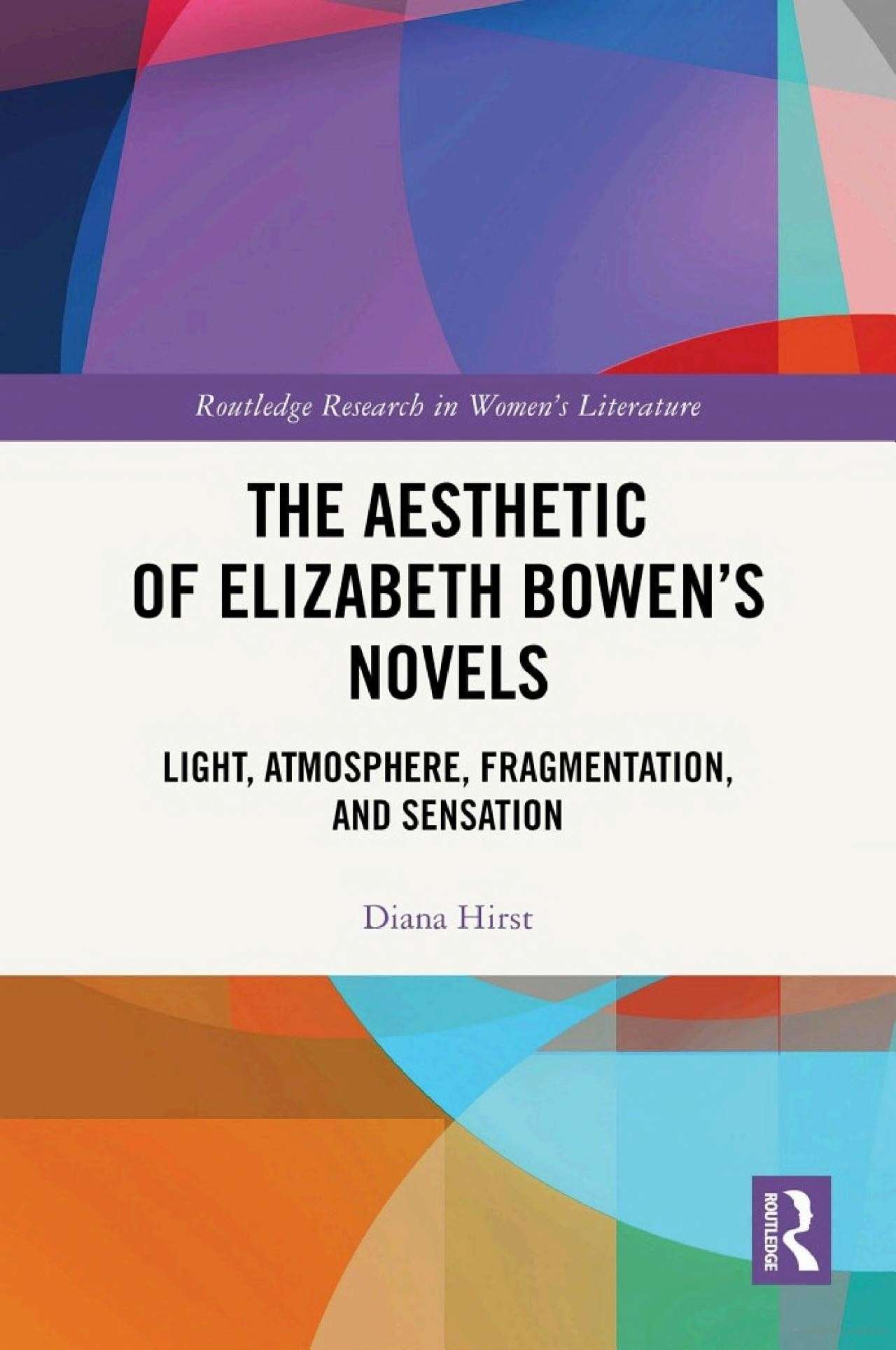
Farah Nada reviews a fascinating new book on Elizabeth Bowen by Diana Hirst
In a pivotal scene from Elizabeth Bowen’s The Heat of the Day (1949), Stella Rodney interrogates her lover, Robert Kelway, about his suspected espionage. Though her question is kept from the reader, the scene is highly charged:
Not a sign, not a sound, not a movement from where she at a distance from him lay, exhausted by having given birth to the question. Her room was bathed in a red appearance of heat from the electric fire; shadows jutted out sharply; a mirror panel reflected the end of the bed on which Robert sat. As though the sensation of this red half-dark of so many nights having within the moment become infernal communicated itself from her to him, he reached across and turned off the fire […]. (p. 267)
This excerpt highlights several issues Diana Hirst takes up in The Aesthetic of Elizabeth Bowen’s Novels: Light, Atmosphere, Fragmentation, and Sensation: Bowen’s plays of light and shadow, her use of mirrors, her literary allusions, and her complex, convoluted syntax. Hirst’s book carefully examines these elements as part of Bowen’s distinctive style – which has both intrigued and frustrated critics – and argues that they should be read and understood as deliberate experimental techniques by a writer forging a unique craft.
Hirst hopes to identify and elucidate Bowen’s ‘individual voice’ (p. 4), tracing its development from early childhood, through her short-lived training as an artist, her experience of the landscapes of Ireland and England – particularly East Kent – and the influence of the artistic, technological, and historical shifts of the twentieth century. Though Bowen remains ‘rooted in tradition’, Hirst notes that she ‘employs an individual, increasingly experimental style’ that puzzles and amazes her readers (p. 1). She argues that Bowen’s writing, influenced by personal and political experiences, aims ‘to create a synthetic form similar to those sought by W.B. Yeats, Marcel Proust, and James Joyce. Above all, she is seeking a composite sensation’ (p. 2).
Hirst’s book is ‘many-faceted’, as Bowen herself was described by her agent, Spencer Curtis Brown.[1] This feels appropriate, given Bowen’s fascination with the kaleidoscope (to which Hirst repeatedly returns), a device that offers ‘a new pattern each time it is twisted’ (p. 2). Hirst’s approach is equally kaleidoscopic; each chapter adds another ‘twist’ to the structures previously identified in Bowen’s work as Hirst cleverly rotates these once-familiar patterns, offering original and unusual perspectives and embracing the disruptions and distortions in Bowen’s style to reveal previously unseen forms and configurations in her writing.
Examining all ten of Bowen’s novels to varying degrees, with mentions of notable short stories such as ‘Mysterious Kôr’ (1944) and ‘Ivy Gripped the Steps’ (1945), each of Hirst’s chapters focuses on one element or technique which, she believes, forms part of Bowen’s unique style. These include Bowen’s use of light and shadow, the prominent ‘place-feeling’ in her works, the influence of art and collage on her highly visual style, the impact of rapidly developing cinematic techniques, and her visual and verbal fragmentation. Taken together, they contribute new, highly informed explorations of Bowen’s style that are sure to delight all readers.
Indeed, Hirst asks that readers ‘take responsibility’ (p. 24) for the reading process. This is something Bowen herself demanded; in Afterthought (1962), she declares that ‘Reading is eventful also’, a statement which echoes across several essays, lectures, and interviews where she underscores what she calls the ‘reciprocal’ process of reading (Collected Impressions, p. 264) In her first chapter, Hirst charts this active and mutual relationship between author and reader, looking at Bowen’s 1946 essay ‘Out of a Book’, her 1950 lecture on ‘The Poetic Element in Fiction’, as well as a speech she gave at Harvard University in 1953 on ‘The Technique of the Novel’, to show how Bowen expected readers ‘to look outside the frame for that which is not obviously there’ (p. 25). ‘What Bowen is hoping the reader will do’, Hirst adds, ‘is twist the imaginary kaleidoscope, thereby presenting different facets or perspectives’, as Hirst successfully does (p. 26).
She also delineates the intuitive process by which Bowen arrives at her stories (and the patterns, scenes, and characters that populate them). Here Hirst explains that her purpose is to hand readers a number of ‘useful tools’( p. 27) with which to approach these works anew: ‘In the end’, Hirst concludes this chapter, ‘it is up to the reader to decode Bowen’s novels’ (p. 27).
Hirst takes her cue from Bowen’s ‘Notes on Writing a Novel’ (1945), in which she breaks down the novel (and her writing process) into constituent parts – plot, characters, scene, dialogue, angle, advance, and relevance – to reveal how a writer should ‘whittle down his meaning to the exactest and finest possible point’ (Pictures and Conversations, p.192). By centring Bowen’s techniques in her own methodical analysis, Hirst examines and defends, through a diverse but compelling focus on light, pattern, art, cinema, and linguistics, the creative choices Bowen makes in order to ‘obliterate words’ (a desire she admits to Walter Allen in a 1955 interview) and provide instead ‘the full possibility of sensation and visual power’ (Weight of a World of Feeling, p. 28).
The value of Bowen’s work is long established. Hirst asks us to embrace a new, much more playful, aim of addressing her ‘peculiar aesthetic’ (p. 220). It is this peculiarity, and the techniques that produce it, that confirm Bowen not only as a worthwhile novelist, short story writer, and essayist, but as an experimental artist with a unique capacity for ‘verbal painting’ (Autobiographical Note).
Hirst’s book offers readers a visual experience, confronting the eyes as well as the mind in a manner Bowen would have approved of. Beginning with the eye’s neuropsychology, Hirst anchors Bowen’s visual writing in the relationship between sight and light. She traces light’s reflective, refractive, and revelatory qualities – which she attributes to the ‘mobile quality of light’ in Ireland and on the Kentish coast (p. 32), revealing how Bowen uses these techniques to create atmosphere, depth, and illusion, and to control perspective, including giving figurative ‘eyes’ to inanimate objects, such as the houses in The Last September (1929) and The House in Paris (1935), that observe her characters’ furtive movements.
Light’s illusory qualities, Hirst notes, are most prominent in A World of Love (1955), whose opening lines overexpose the narrative’s underlying tensions:
The sun rose on a landscape still pale with the heat of the day before. There was no haze, but a sort of coppery burnish out of the air lit on flowing fields, rocks, the face of the one house and the cliff of limestone overhanging the river. […]. This light at this hour, so unfamiliar, brought into being a new world – painted, expectant, empty, intense. (p. 9)
Hirst comments that ‘light never really settles’ in this novel ‘but moves around, distorted by the heat, which causes mirages’, such as the revenant Guy, the house’s former proprietor who died in the First World War, and whose letters are found in the attic, triggering the novel’s events (p. 45). ‘It is the illusory nature of much of A World of Love’, Hirst adds, ‘which Bowen portrays and which its characters have to learn that they can never take hold of nor comprehend’ (p. 46).
Hirst’s attention to the visual and ocular here provides a foundation for her subsequent discussions of art, where she pays close attention to Bowen’s literary chiaroscuro, particularly in Friends and Relations (1931) and Eva Trout (1969), and her examination of cinematic language and techniques in The House in Paris, The Death of the Heart (1938), and the wartime and post-war novels. In these works, light’s technical elements are underscored through Bowen’s ability to produce motion, shift focus, and alter narrative perspective. Though Bowen confesses having no understanding of how cinematic effects are achieved, Hirst observes that she certainly ‘knows how to replicate the effects in her prose and can recognise them in the writing of others’ (pp. 173–4).
Hirst’s discussion of Bowen in relation to art genres in Chapter Four will delight readers and artists alike, as will her analyses when she brings individual scenes in conversation with the works of specific artists, including Pierre Bonnard, Paul Cézanne, Giorgio de Chirico, and Umberto Boccioni. Though Hirst touches on all the novels here, one particularly engaging reading is of an unusual moment in Friends and Relations, one of Bowen’s more neglected works, during which the narrative voice shifts to using the pronoun ‘you’, altering the scene’s spatial and temporal dimensions. Hirst draws interesting parallels here with the Futurism of Boccioni’s ‘force-lines’, specifically in ‘The Farewells’ from his triptych States of Mind (1911), to show how Bowen repeatedly changes the placement of the ‘camera-eye’ and injects movement and dynamism into what is, like Boccioni’s painting, a heightened moment of departure (pp. 119–21).
Hirst’s final chapter situates Bowen alongside those who participated in the early-twentieth century’s ‘revolution of language’ (p. 202), coining the term ‘dyslocution’ (or ‘disordered locution’ (p. 11 n.6)) to capture the fragmentation and intentional obliteration of her syntax. She attends to the influence of the French language on Bowen’s writing, her often-frustrating double and triple negatives, and her use of poetic techniques such as rhythm and alliteration to reveal Bowen’s ‘verbal Cubism’ (p. 202). Tracing Bowen’s verbal fragmentation from as early as her first novel, The Hotel(1927), Hirst demonstrates how this develops through Bowen’s exposure to Futurism and the events of the Second World War, when she aims to register a distortion, as though looking through a cracked kaleidoscope (p. 208). In The Heat of the Day, Hirst reveals how sentences are convoluted in a manner consistent with a spy novel or wartime thriller in which nothing is what it seems: ‘she for the last time turned, looked, with her big lips parted, then was with startling completeness gone’ (p. 21); ‘In the street below, not so much a step as the semi-stumble of someone after long standing shifting his position could be, for the first time by her, heard’ (p. 290).
Hirst ends this final chapter with a discussion of ‘Oh, Madam’ (1940), Bowen’s most ‘Cubist’ short story, whose fragmented monologue and use of ellipses break up sentences to record the destruction:
No, I’m all right, madam, really … Do I? Not more than you do, I’m sure. This is a home-coming for you – after that nice visit. I don’t know what to say to you – your beautiful house! There usen’t to be a thing wrong in it, used there, madam? I took too much pride in it, I daresay … I know, madam, the stairs – all plaster. (Collected Stories, p. 647)
For Hirst, these moments are deliberate choices of a technically adept, experimental artist whose aim was to startle and amaze.
Amazement is certainly the experience of Hirst’s own reader, whose attention is held by her revealing close readings and the archaeological rigour with which she follows Bowen’s clues to generate what I believe may become an encyclopaedic reference for Bowen’s style. In both form and content, The Aesthetic of Elizabeth Bowen’s Novels brings to Bowen studies a new and revised analytical vocabulary. Importantly, despite addressing various facets, Hirst treats Bowen’s work as an oeuvre, allowing patterns and connections to emerge between texts that others have often struggled to discuss in the same breath or which, like her early or late works, have felt disconnected from her popular novels of the 1930s and 1940s. If the reader feels somewhat overwhelmed by the layers Hirst peels back, returning as she does to the same novels and scenes from different perspectives, it is because she leaves work for them to do. In lieu of a conclusion, Hirst ends with an invitation, ‘holding out the baton’, as she says, for further research on these and other aspects of Bowen’s peculiar aesthetic.
Farah Nada, Elizabeth Bowen Society
Ottawa, Canada
Diana Hirst, The Aesthetic of Elizabeth Bowen’s Novels: Light, Atmosphere, Fragmentation, and Sensation (Routledge, 2026). 9781040709207. For a short time, the publisher is offering a 50% discount. Voucher here.
[1] Forward, Pictures and Conversations (1975), p. ix.