Book Review: The Invention of Charlotte Brontë
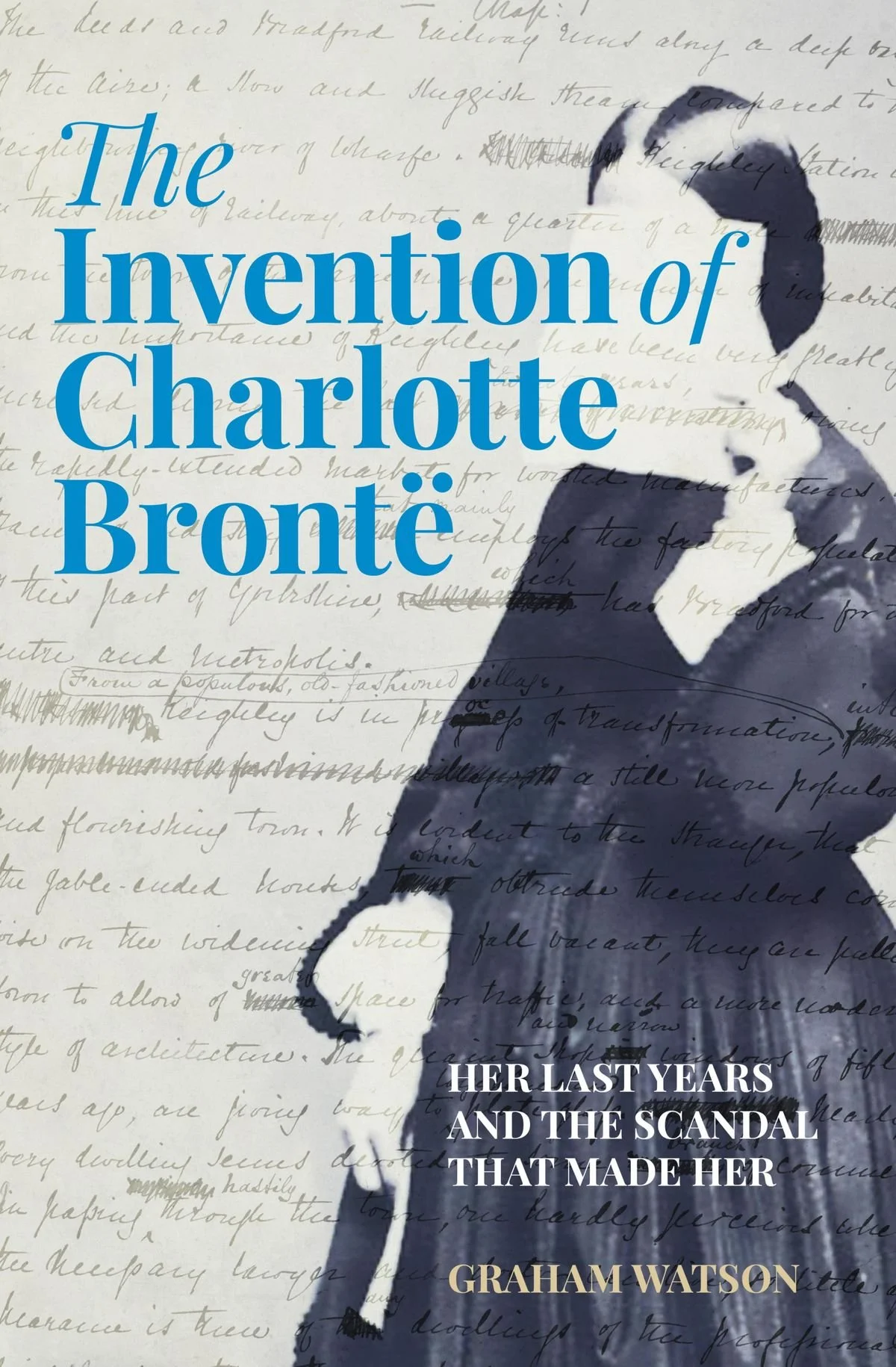
Mitchell Alcrim reviews The Invention of Charlotte Brontë: Her Last Years and the Scandal that Made Her, by Graham Watson
(The History Press, 2025)
Graham Watson’s The Invention of Charlotte Brontë is an enthralling read. Written with exceptional narrative skill, the book is roughly divided into two halves. The first is an account of the last five years of Charlotte Brontë’s life, which, while traditionally viewed as a sort of epilogue following the untimely deaths of her three siblings, Branwell, Emily, and Anne, are here reframed by Watson as a rich period of creativity and self-determination. In the second section, Watson unfolds the complex story of the writing of Elizabeth Gaskell’s biography of Charlotte and the controversy attendant on its publication in 1857.
Forgoing the formal introduction that one might expect in a literary biography, Watson makes the bold decision to plunge the reader directly into the story. In a keen yet subtle echo of the journey with which Elizabeth Gaskell will open her landmark biography of Charlotte, he also commences his book with a description of travel. (18) The reader accompanies Gaskell on her way to the home of some friends, the Kay-Shuttleworths, where she will finally meet the ever-elusive Currer Bell, author of the infamous novel, Jane Eyre. Long suspected to be a woman, Currer had been unveiled as ‘the only daughter of the Rev. P Brontë … the authoress of Jane Eyre and Shirley’ in the British press earlier that year, in February 1850. (25-26)
Elizabeth Gaskell recounted her first impressions of Charlotte Brontë to a friend on 25 August remarking that ‘[s]he is (as she calls herself) undeveloped’ but with ‘a sweet voice’ whose expressions are ‘admirable and just befitting the occasion.’ (18) Even as early as this first meeting, Elizabeth remembered that Charlotte ‘talked about how she and three of her sisters were sent to a brutal boarding school where they were fed scraps hardly fit for animals.’ Charlotte went on to mention that ‘it was all in Jane Eyre, and she could not have imagined such a hell had she not experienced it.’ (31) Elizabeth wrote to friends about this initial encounter, ‘combining [her hostess] Janet’s gossip … with her own assessments.’ (39) Diminutive in stature, Elizabeth wrote that ‘[Charlotte’s] stunted person she ascribes to the scanty supply of food she had as a growing girl, when at that school of the Daughters of the Clergy … [s]he is truth itself’ … ‘the last of six; liv[ing] in a wild out of the way village in the Yorkshire Moors with a wayward eccentric wild father’. (39) Patrick Brontë is characterised as ‘prone to violent outbursts’ – and as someone who had, at various times, set fire to a hearth-rug, ‘destroy[ed] [his children’s] colourful shoes and depriv[ed] them of meat to staunch vanity and indulgence.’ (40)
Watson considers how Lady Janet could have possibly known all these details of Charlotte’s life when they were yet little more than acquaintances. He posits that Charlotte herself was the source of many of these stories. He argues:
As the stories of her deprivations and defeats finally overcome are more self-justifying than speculative, more self-preserving than the interests of gossips, they indicate origins more intimate than the prurience of Brontë acquaintances, or in any embellishments by Janet. (40)
Charlotte engages in a kind of self-fashioning and asserts herself as a witness to her own life; as Watson indicates, ‘only one subjective perspective remains consistent: Charlotte’s.’ (41) Harriet Martineau was the recipient of similar stories from Charlotte; indeed, Martineau remarked that during an intense two-hour long conversation on the evening of their first meeting, Charlotte eagerly volunteered ‘her name and the history of her life’. (41) As Watson describes it, these ‘set-piece anecdotes about how the comfortless childhood produced an isolated adulthood’ were ‘Charlotte’s courtship with the outer world, her way of drawing people into her influence and keeping them there.’ (41) He argues that these stories would become foundational in the creation of Elizabeth’s biography of Charlotte and the subsequent evolution of the ‘Brontë myth’ – ‘[a]t its core’, he writes, ‘this mythology contains the fugitive pieces of Charlotte’s own autobiography never committed to paper.’ (42)
In earlier studies of the Brontës, Charlotte has often been portrayed as jealous of her sisters’ work with some commentators even going so far as to suggest that she may have destroyed an unfinished novel by Emily. Watson, however, maintains that rather than sabotaging them, she was, in fact, the catalyst for the reissue of both Anne’s The Tenant of Wildfell Hall and Emily’s Wuthering Heights, both of which appeared to have sold out and never been reprinted. In October 1850, as the anniversary of her siblings’ deaths approached, Charlotte found a loophole in her sister’s agreements with their publisher and convinced her own, Smith Elder, to reissue the books. (46) Besides correcting errors, she set to work on writing prefaces to the new editions of her sisters’ novels. Watson points out that rather than rehabilitating their work ‘for critical judgement’, her intention was ‘to preserve what was more fleeting, their personalities.’ (46-47) Regarding this work as ‘a sacred duty’, it nevertheless depressed her – writing to her childhood friend, Ellen Nussey, she confessed that ‘my loathing of solitude grew extreme; my recollection of my sisters intolerably poignant.’ (48) Of Anne she wrote that: ‘She was a very sincere and practical Christian, but the tinge of melancholy communicated a sad shade to her brief, blameless life’, while in Emily ‘lay a secret power and fire that might have informed the brain and kindled the veins of a hero; but she had no worldly wisdom …’ (49) In both cases, she makes it clear that there was a clear divide between the contents of the novels (which some had denounced as coarse and indecent) and the women who wrote them. Watson writes that ‘Charlotte was keen to emphasise that the elements of [their] fiction considered grotesque and vulgar demonstrated a faculty for unfiltered observation, rather than being the expressions of an unfit mind.’ (50) ‘[F]or those who had known them all their lives in the intimacy of close relationship,’ Charlotte wrote, ‘they were genuinely good and truly great.’ [51] Watson argues:
Writing candidly in a way their reticence had once prohibited, this was not only Charlotte’s love letter to the past but her plea for it to end. Without agency or breath, Emily and Anne, who chose to live in realms of their own invention, would be forever characters in a new story started by their sister. (51)
It is as if with her efforts to restore their personal reputations, she had at long last laid them to rest. As Watson interprets it:
Independent in name and identity from them now all three were necessarily separated, she resolved to cleave away from their creative and emotional counsel and take her first steps into an as yet unwritten future. (51)
These final years of Charlotte Brontë’s life were, as Watson shows us, both personally and professionally productive. During this time, she published the novel Villette (which Virginia Woolf, incidentally, thought her very best), married her father’s curate, Arthur Bell Nicholls, exchanged numerous visits with Gaskell and other friends, and both met and fell out with one of her literary idols, William Makepeace Thackeray.
Charlotte Brontë considered Thackeray to be England’s greatest living writer, and when writing to friends, she spoke of his ‘inherent genius’ which made him ‘a writer unlike other writers.’ As Watson explains, she ‘pictured a man both elemental and earthy, an eternal talent amongst mortals’. (66) Most commonly viewed as one of Charlotte’s most ardent champions, the man we encounter in Watson’s detailed recounting of their three meetings is someone quite different. Each more cringe-inducing than the next, every episode reveals what can only be described as a misogynistic contempt for her. He did not miss an opportunity to unsettle her by making her a spectacle and a figure of fun (she was notoriously shy), and then, at their last meeting, he went so far as to introduce her to his mother as Jane Eyre. (76) Later, when Thackeray visited her at her publisher George Smith’s house, she confronted him. George witnessed the scene:
The spectacle of this little woman, hardly reaching to Thackeray’s elbow, but somehow looking stronger and fiercer than himself, and casting her incisive words at his head, resembled the dropping of shells into a fortress. (78)
George knew that ‘[Thackeray] did not like [her], and the two did not get on well together’, and yet he persisted in orchestrating encounters between them. Watson argues that, heedless of Charlotte’s discomfort, George, in his desperation to sign Thackeray as a client, used Charlotte as bait to attract him. (73) He ultimately succeeded, and Smith Elder published Thackeray’s novel, The History of Henry Esmond in 1852. (82)
George Smith, too, undergoes a process of demystification by Watson. Long viewed as a type of romantic hero in accounts of Charlotte’s life, here Watson provides strong evidence that George was an opportunist and that their relationship, at least on George’s part, was strictly about business. Perhaps, in time, Charlotte herself realised this – a few years later, as she prepared to wed Arthur, she composed her final letter to George. In it, she wrote that ‘the links of communication have waxed very frail and few … All things considered I don’t wish it otherwise.’ (146)
After Charlotte Brontë’s death in 1855, many scurrilous articles began to appear in the press. To counter these, Ellen recommended to Patrick that he ask Elizabeth Gaskell (the ‘perfect candidate’) to write an account of Charlotte’s life. (191) She chose wisely. Over the course of the six years prior to her death, Charlotte and Elizabeth had forged strong bonds of friendship. Each could provide what the other lacked – ‘Elizabeth had a place in Haworth when she needed solitude and simplicity, and for Charlotte, the warm, vivacious opposite in Manchester.’ (130) And, of course, both were writers. More than this, as Watson writes, ‘[b]oth expressed hidden aspects of their personalities in their novels and used them to exercise those aspects of their natures which found no outlet in daily life.’ (104) Indeed, Elizabeth herself stated:
The difference between Miss Brontë and me is that she puts all her naughtiness into her books, and I put all my goodness. I am sure she works off a great deal that is morbid into her writing and out of her life; and my books are so far better than I am, but I often feel ashamed of having written them, as if I were a hypocrite. (104)
Elizabeth’s connection to Charlotte was the product of six years of shared correspondence and conversation, the substance of which would ultimately form the basis of The Life of Charlotte Brontë.
Even before she was formally engaged to write The Life, Elizabeth contemplated writing something about her friend: ‘if I live long enough … I will publish what I know of her, and make the world honour the woman as much as they have admired the writer.’ (186) This differentiation between woman and writer, and perhaps, by extension, woman and legend, is an interesting notion to ponder, and it suggests that, from the very start, Gaskell was determined to tell the unvarnished truth about Charlotte Brontë and her life.
And yet, so many questions about how to proceed. She had never written a biography and confessed: ‘I don’t know exactly how to set about it; … I have to be accurate and keep to facts’. (222) Her research techniques were exhaustive; she interviewed everyone she could find who had known the Brontës and viewed many of the locations Charlotte had visited as well, including Cowan Bridge, the school which was allegedly the model for the Lowood school in Jane Eyre. (205)
Elizabeth told Patrick that she hoped to ‘make his daughter’s most unusual character (as taken separately from her genius) known to those who, from their deep interest and admiration of her writings would naturally, if her life was to be written, express to be informed as to the circumstances which made her what she was.’ (197) Elizabeth believed that as her biographer it was her duty to privilege Charlotte’s perspective and to tell the ‘unmediated truth’ about her life and circumstances. (255)
Drawing from the hundreds of letters lent to her by Ellen Nussey and which spanned their lifelong friendship, she decided that rather than paraphrasing their contents, she would quote extensively from them. ‘Having been silenced in life by the men around her and now by death, Charlotte [would] be allowed to speak’. (207) Watson’s book is similarly chock full of judiciously chosen extracts from personal letters which greatly enliven his narrative, providing a strong sense of intimacy and immediacy.
Telling the truth would have its consequences, but Gaskell truly believed that:
Charlotte’s comfortless life – of sacrifices and duty to her father, her brother, to her employers, to the many who knew they could exploit an emotionally damaged woman who only sought meaningful connection – deserved a compensation of glory denied to her in life. (258)
The biography would become ‘an act of revenge, executed by her on behalf of Charlotte and in tribute to her.’ (259)
The Life of Charlotte Brontë was published in the spring of 1857. It was generally acclaimed, with one paper calling it ‘one of the profoundest tragedies of modern life’ and another referring to it as ‘the desolate record of a brilliant but desolate career.’ (269) However, complainants did come forward, most notably Patrick Brontë, Lady Lydia Scott (with whom Branwell allegedly had a sexual liaison, which the Brontë family believed had led to his decline and death), and the son of the founder of the Cowan Bridge school. All claimed to have been libelled in Elizabeth’s biography of Charlotte. All demanded retractions and omissions; lawsuits were threatened. (274-288) Her publisher, George Smith, fearing that they could all be successfully sued for slander and thereby face ruination, urged that retractions and omissions be made as quickly as possible. (277)
Exhausted by the allegations of wilful fabrication of evidence, Elizabeth drafted a redacted third edition. (288) Desperate to be done with what she now bitterly referred to as that ‘unlucky book’, (307) she then ‘collated the lists of everyone’s objections … [and] marked the offending sections she planned to cut and revise’. (288)
Watson effectively challenges the received wisdom which holds that Elizabeth Gaskell’s biography of Charlotte Brontë is unreliable and untrustworthy. He champions her as a ‘whistleblower’ whose primary duty in the writing of her book was to tell the whole truth about Charlotte’s life in order to paint a complex portrait of the circumstances and conditions which shaped her. For decades, it has been assumed that the omissions Elizabeth made were an admission that she had invented evidence and was wilfully inaccurate. In his book, Watson convincingly argues (and provides hard evidence to support it) that the decision to omit or retract was pragmatic and was made at the insistence of her publisher under the threat of litigation.
Amid the controversy, Elizabeth wrote to Ellen:
I believe now that I hit as near the truth as any one could do. And I weighed every line with all my power and heart so that every line should go to its great purpose of making her known and valued as one who had gone through such a terrible life with a brave and faithful heart. But I think you know and knew all this. One comfort is too that God knows the truth. (278)
One of the most admirable qualities of the book is that Watson permits the narrative to unfold naturally, and often suspensefully. Although he introduces much that is new, he does so without announcing it, with not a hint of self-aggrandisement. Watson allows the individuals about whom he writes to maintain their personal integrity as real people who lived real lives – this is their story. By quoting extensively from letters, both published and unpublished, he allows his ‘characters’ to emerge truthfully, with nuance and complexity.
Graham Watson’s The Invention of Charlotte Brontë is a laudable contribution to Brontë studies and to the art of literary biography. Beautifully written and meticulously researched, it is a pleasure to read. Overturning much of what we thought we knew about Charlotte Brontë and her family, it is a spellbinding work which invites us to reconsider the Brontë legend and its origins.
Mitchell Alcrim
Cambridge, Mass.
We will study Charlotte Brontë’s Jane Eyre and Villette alongside the writings of her sisters Emily and Anne, plus some juvenilia of all four Brontë children, in our Brontës Season, September 2026 to March 2027.