Between Earth and Sky in Between the Acts (1941)
Ellie Mitchell reflects upon the lecture she will give in the 2026 summer course.
Our theme is Woolf and the Natural World.
As the spring sunshine finally begins to warm the sandstone tenements of my street in Edinburgh, I am turning my attention to this year’s Literature Cambridge summer course on Virginia Woolf and the Natural World. My lecture for the course will focus on Between the Acts (1941), and on the importance to the novel of the earth, the sky, and the spaces in between.
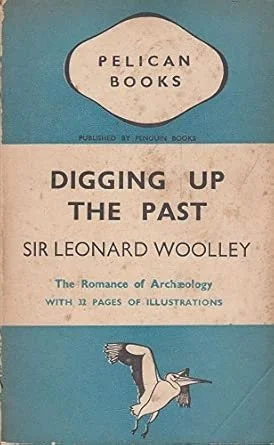
I plan to read the novel’s setting – ‘a hollow [...] in the very heart of England’ – as an archaeological site and the novel’s pageant as an archaeological dig. This topic is something of a personal relic in itself, dug out from my own scholarly archives, and I have been having a wonderful time dusting it off and polishing it up for the summer course. I first became interested in the archaeological aspects of Between the Acts almost ten years ago, when I was but an aspiring Woolf scholar, an undergraduate at Cambridge, and very frankly in the depths of despair. I was desperately casting about for a topic for my final-year dissertation and, on a particularly despondent walk to the market, I found Digging Up the Past by Sir Leonard Woolley.
This was a find indeed, serendipitously discovered in the depths of a huge mailbag of similar penguin paperbacks which was tucked away beneath my favourite second-hand bookstall. For the low, low price of one singular Great British Pound, I bought it, and returned to my rooms in college, thrilling with thoughts of all the references to land and ground and earth and digging and dredging which I had been tracing through Between the Acts but had so far failed to thread together.
Leonard Woolley’s Digging up the Pastis based on a series of talks which were broadcast by the BBC and first published as a book in 1930. It was republished in 1937, and then reprinted again in 1942 in this edition, which includes the following inscription:
FOR THE FORCES
Leave this book at a Post Office when
you have read it, so that men and women in the services may enjoy it too.
This inscription remarkets the book specifically for wartime, and so recontextualises its content and educational aims. In Digging up the Past, Woolley writes of ‘the romance of archaeology’ in a style which aims to make the field accessible to the general public, to Woolf’s ‘common reader’, or indeed to the common serviceman or woman. In his introduction, he argues:
The importance of our archaeological material is that it throws light on the history of men very like ourselves, on a civilization which is bound up with that of to-day.
[…]
Today we can see that modern man did not begin his career in 500 B.C., not even perhaps in 5000 B.C.; from the flower of Attic culture we can work back and find the roots spreading far afield, and sending up perennial blossoms all differing with the nature of the soil and the tending they have received, but all of one stock, and in the light of such knowledge we can better judge and control the present and the future growth. And this enlightenment is not merely for the specialist, for the research student in history. The opening-up of the world affects us all, becomes part of the general intellectual inheritance, and the justification of archaeology is that it does in the end concern everyone.[1]
He concludes the book, too, with the claim that the field archaeologist ‘makes real and modern what otherwise might seem a far-off tale’.[2]
It seemed to me as an undergraduate, and it still seems to me now, that Woolley’s Digging up the Past has much in common with Woolf’s Between the Acts. In Digging up the Past, the ‘romance of archaeology’ is a soothing tale told to counter the nightmares of the Second World War. The recovery of the past, and of every person’s natural and deep-rooted connection to every other person, appears as a reassuring possibility in the midst of conflict and in the face of an uncertain future. Woolley presents this interpretation of the archaeological record as one of ‘enlightenment’, or as an ‘opening-up of the world’. It is certainly one which enlightens and opens up Between the Acts.
As my lecture will explore, the setting of Between the Acts is local and parochial. The novel dwells in a ‘hollow’, but its small geographical scope exists in direct disproportion to the immense historical scope of its pageant, which tells the story of England from the moment at which it ‘sprung from the sea’ to the present-day interruption of warplanes passing overhead.
This spatio-temporal dynamic can also be identified in the correspondence between the notable sources for or influences upon the novel, as the regional interests of Gilbert White’s The Natural History of Selbourne (1789) and the Sussex Archaeological Collections expand into the grand narratives of Charles Darwin’s On the Origin of Species (1859) and H. G. Wells’s The Outline of History (1920). This latter book literally bookends Between the Acts. Lucy Swithin can be found perusing its pages at the beginning and end of the novel, suggesting the novel’s synecdochic encapsulation of history within a single day.
In Between the Acts, then, we find Woolf not in the role of wandering flâneuse or drawing-room observer, but of archaeologist, selecting a specific site on which to dig in the hope of uncovering common ground. Like Woolley, she would seem to propose that remembering the past in the present reminds us that there is also a future. Through its digging and dredging, its movements up towards the sky, and the mediating fall of rain, Between the Acts performs the ups and downs of history – and so, like my twenty-one year-old self at the Cambridge market, Woolf serendipitously pulls a book out of the bag, and finds some semblance of hope in the depths of despair.
I am so looking forward to digging into Between the Acts and so much more with our students on the Woolf courses both online and in Cambridge this summer. They are always a joy, and there is always something new to be unearthed.
Ellie Mitchell, University of St Andrews
Lecturer, Literature Cambridge
[1] Leonard Woolley, Digging up the Past: The Romance of Archaeology (Penguin, 1930; repr. 1942), p. 10.
[2] Woolley, Digging up the Past, p. 61.